


Coaching Young Minds
Understanding the how behind the learning
Earlier this week, we were delighted to welcome parents to Amesbury for a Teaching & Learning event: Coaching young minds – understanding the how behind the learning.
Parents began by attending a live English lesson with Jo Kean, the aim of which was to offer insights into what learning at Amesbury can feel like from the pupil perspective: the demands of lesson pace and content, sustained attention, the moments of challenge, the necessity – and support – of uncertainty. By sitting in the lesson, parents were able to experience first‑hand the culture and some of the routines and strategies we deliberately build to support engagement, thinking and independence.
Following the lesson, parents joined Jo, together with Dr Tom Smiley, for a working lunch to explore the rationale behind the lesson’s content, structure and delivery. These conversations focused on why we teach in the ways we do: how lessons are started and sequenced, how content is delivered and how thinking is modelled and shared, without removing the appropriate degree of independent cognitive struggle. Dr Smiley’s insights into neuroscience and child brain development further explained the links between cognitive load and emotional regulation, lesson content and our current teaching & learning priorities and approaches.
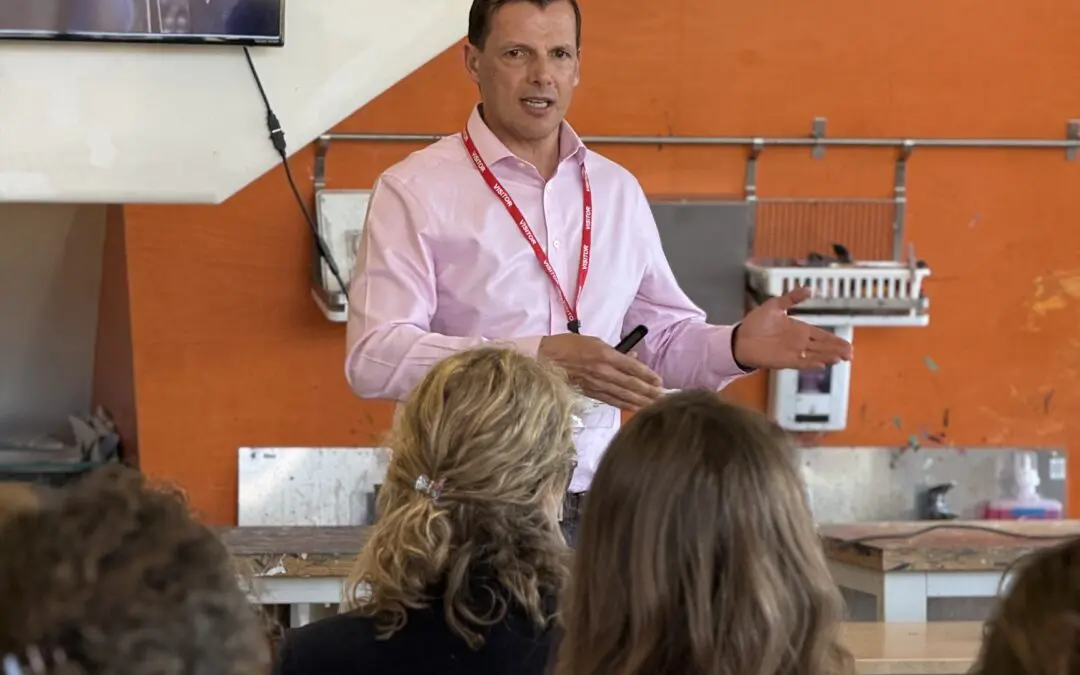
Two afternoon sessions broadened this thinking further, focusing on how parents can best support learning beyond the classroom. We were fortunate to welcome two outstanding visiting speakers to lead these sessions: Kim Wells, Director of Training and Research at Caterham School, also an International Coaching Federation accredited coach, and Richard Shorter, widely known as the the Non‑Perfect Dad. Both Kim and Richard also offered sessions for pupils and teaching staff respectively, to further join the dots.
As an experienced teacher and senior leader who has spent over a decade designing school‑wide approaches to ‘learning how to learn’, Kim shared practical ways parents can encourage independence, reflection and resilience rather than performance alone. His work at Caterham School is nationally recognised for placing learning processes at the centre of pupils’ education. Kim challenged parents to resist the urge to ‘lawnmower a clear path through the grass’ and instead help children to identify and deploy the strategies within their own learning toolkits.
Richard Shorter complemented this in his talk by drawing on his work with schools, families and elite sports organisations, exploring the idea of ‘not stealing the struggle’ a concept central to his philosophy. He encouraged parents to reflect on when support can become interference, and how well‑intentioned rescuing can unintentionally undermine resilience and self‑belief. Using powerful examples from both his own family and sport, Richard demonstrated how the thinking and coping strategies children develop on the pitch can be consciously transferred into other spheres of their lives.
Across the day, we aimed to share a central and aligned message: learning is not without difficulty, but pedagogical research and evidence-based approaches, combined with the professional expertise of Amesbury teachers, means we can support Amesburians in a joined-up and holistic way. Learning is not about removing difficulty but about equipping young people – we teachers and parents alike – to navigate it with resilience.
We are hugely grateful to Kim Wells and Richard Shorter for their expertise and provocations, and to all parents who attended and engaged so thoughtfully.